%%USERNAME%%    %%ACCWORDS%% %%ONOFF%% |

 Items to fit into your overhead compartment |
|
Carrion Luggage 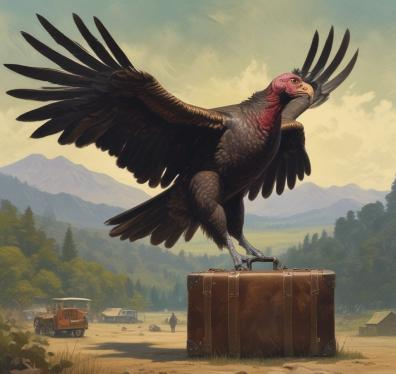 Native to the Americas, the turkey vulture (Cathartes aura) travels widely in search of sustenance. While usually foraging alone, it relies on other individuals of its species for companionship and mutual protection. Sometimes misunderstood, sometimes feared, sometimes shunned, it nevertheless performs an important role in the ecosystem. This scavenger bird is a marvel of efficiency. Rather than expend energy flapping its wings, it instead locates uplifting columns of air, and spirals within them in order to glide to greater heights. This behavior has been mistaken for opportunism, interpreted as if it is circling doomed terrestrial animals destined to be its next meal. In truth, the vulture takes advantage of these thermals to gain the altitude needed glide longer distances, flying not out of necessity, but for the joy of it. It also avoids the exertion necessary to capture live prey, preferring instead to feast upon that which is already dead. In this behavior, it resembles many humans. It is not what most of us would consider to be a pretty bird. While its habits are often off-putting, or even disgusting, to members of more fastidious species, the turkey vulture helps to keep the environment from being clogged with detritus. Hence its Latin binomial, which translates to English as "golden purifier." I rarely know where the winds will take me next, or what I might find there. The journey is the destination. |
| Today, I'm featuring this article from LiveScience. This is not what I'd call a trustworthy source, but I found the article amusing enough to share. What's the darkest place in the solar system? What about the universe?  Space looks very dark from Earth. But does the solar system, and the universe for that matter, have an area that's the darkest of all? What's the darkest place in the universe? My heart, of course. ...yes, I did save this questionable article for the sole (pun intended) purpose of making that joke. Look into the night sky, and it might seem like space is a vast expanse of darkness. Making me feel right at home. But are any regions darker than others? Questions like that are what make me distrust this source. It should be painfully obvious to anyone with a working brain that some regions of space would have to be darker than others. The illuminated side of the moon, e.g., as compared to the... you know. In short, the answer isn't straightforward, and it depends on whom you ask, experts told Live Science. I imagine it would depend on one's definition of "darkness." We only see a small sliver of the EM spectrum. Do we limit the answer to light visible to humans, or expand it to include things like radio waves and gamma rays? True darkness, the blackest black, is surprisingly rare and hard to pinpoint. "It's like, how much more black could this be? And the answer is none. None more black." -Nigel Tufnel ...okay, I also saved this article so I could make a Spinal Tap reference joke. My alternative joke for this line involved Vantablack and Anish Kapoor, but I'm going with the Spinal Tap one in memory of Rob Reiner. This is because there is a lot of dust in the cosmos: Dust scatters light, making space glow far beyond stars... That's my excuse for not cleaning: the room's brighter when it's dusty. As a result, there is a background glow that permeates much of the universe. (The color of the universe is actually "cosmic latte," a beige shade not too far off white.) See, saying stuff like that may be true, but you need to explain it better lest people snort and say stuff about "common sense," and dismiss anything science comes up with as a result. Darkness also "depends on how you define it," Andreas Burkert, a theoretical astrophysicist at the University of Munich, told Live Science. Okay, I'm not the only one who quibbles about the EM spectrum. If you consider only visible light, there are some exceedingly dark places in space. And they all work in law firms. Firstly, cosmic objects can be made of light-absorbing material, making them appear very dark. Scientifically, this is known as albedo, or the amount of light reflected off a surface. We think of the illuminated surface of the moon as bright. But it's really rather dark, as anyone obsessed enough to pick up the background dialogue from Pink Floyd's greatest album can attest. The nucleus of comet Borrelly (also called 19P/Borrelly) is one of the darkest spots in our solar system, according to the Guinness Book of World Records. I trust Guinness World Records even less than this source. But wouldn't the interior of any planet be pretty damn dark in visible light? Black holes, too, are dark because they capture light that crosses the event horizon. But interestingly, "that doesn't mean that there is no light," Burkert said. "It simply is trapped." As a result, "when you enter the black hole, it's actually extremely bright," he explained. And stuff like this is misleading as hell, too. If the light is trapped, there is no light, from an outside perspective. And if you "enter the black hole," you're not coming back out to report on its brightness. And furthermore, we've all seen images of accretion disks around a black hole, which are, for various reasons, really bright. So anyway. There's more at the link. Like I said, it's an interesting question, and not one with an easy answer... unless you're a comedian. |
 View Portfolio
 Visit Notebook
 Send Gift Points
 Awards
 Badges
 Send Email


 Community Newsfeed
 Puzzle Hub
 General Discussion
 Sponsored Items
 Book of Trinkets
 Static Items
 Books
Books Groups
 Interactive Stories
 Audio
Audio Campfire Creatives
 Community Notes
 Crossword Puzzles
 Documents
 Folders
 Images
 In & Outs
 Madlibs
 Photo Albums
 Polls
Polls Product Reviews
 Quizzes
 Survey Forms
 Web Pages
 Word Searches


