%%USERNAME%%    %%ACCWORDS%% %%ONOFF%% |

 Items to fit into your overhead compartment |
|
Carrion Luggage 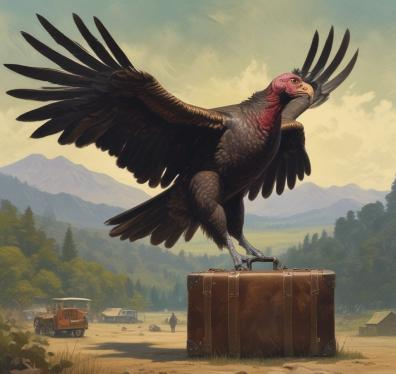 Native to the Americas, the turkey vulture (Cathartes aura) travels widely in search of sustenance. While usually foraging alone, it relies on other individuals of its species for companionship and mutual protection. Sometimes misunderstood, sometimes feared, sometimes shunned, it nevertheless performs an important role in the ecosystem. This scavenger bird is a marvel of efficiency. Rather than expend energy flapping its wings, it instead locates uplifting columns of air, and spirals within them in order to glide to greater heights. This behavior has been mistaken for opportunism, interpreted as if it is circling doomed terrestrial animals destined to be its next meal. In truth, the vulture takes advantage of these thermals to gain the altitude needed glide longer distances, flying not out of necessity, but for the joy of it. It also avoids the exertion necessary to capture live prey, preferring instead to feast upon that which is already dead. In this behavior, it resembles many humans. It is not what most of us would consider to be a pretty bird. While its habits are often off-putting, or even disgusting, to members of more fastidious species, the turkey vulture helps to keep the environment from being clogged with detritus. Hence its Latin binomial, which translates to English as "golden purifier." I rarely know where the winds will take me next, or what I might find there. The journey is the destination. |
|
Another story about elements, this time from, believe it or not, Irish Times. Boy (7) strikes it lucky by finding one of the world’s rarest minerals near his home in Cork  Within seconds of handing it over to an expert, it was clear quartz discovery was very special Around lunchtime on March 1st, 2024, Patrick Roycroft, geology curator at the National Museum of Ireland, was given a piece of mineral, about the size of a Creme Egg, by a seven-year-old boy called Ben O’Driscoll. I wanted to talk about this without making Irish jokes, but that's not going to happen. For example, those are about the most Irish names that ever Irished. Just a few weeks earlier, in mid-February, Ben had returned home after soccer practice one Saturday morning and had decided to explore a field near his home in Rockforest East, near Mallow in Co Cork. I'm going to have to assume that "had decided to explore" meant "found the end of a rainbow." When he showed his mother, Melanie, what he’d found, she sensed he’d struck it lucky. Post your leprechaun jokes in the comment section. I'm already feeling the hot, burning stares of my Irish friends. Roycroft knew exactly what he was looking for. Within seconds, he realised what he had in his palm was genuine: a true cotterite, one of the rarest forms of quartz in the world. Okay, here's where I stop making fun. Quartz is, according to what I found on the internet, the second-most common mineral in the lithosphere (only feldspar is more common, and that may be cheating because there's not one single elemental composition to feldspar). It's made of silicon and oxygen. Quartz, by itself, is basically dirt. Well, sand, anyway. There's nothing uncommon about silicon dioxide, is all I'm saying.But, much as carbon can be graphite or coal or diamond, there are situations that can make quartz rare and valuable. Add iron to the matrix and subject it to gamma rays, for example, and you get amethyst (which still isn't all that rare, but it sure is pretty). And I'd never heard of cotterite. What Ben had found was the first discovery of cotterite in 150 years. That's genuinely cool. There are about three dozen known authentic cotterite specimens, which are held by museums in Cork, Dublin, London and even the Smithsonian in Washington. They were all found within a few months of each other and derive from a single horizontal vein of calcite, quartz and ferruginous mud cut through carboniferous limestone in Rockforest. I understood most of those words. I didn't know "ferruginous," but I guessed it had something to do with iron, and, as usual, I was right. What amused me was that the place name is Rockforest. It was formed in a single geological event under conditions so specific that, as far as scientists know, they have never been repeated anywhere else in the world since. A bit misleading, maybe. I might have put it "has never been found anywhere else in the world since." This tale has one character: a woman called Grace Elizabeth Cotter, who grew up in Knuttery, a townland near Rockforest in Cork. Ah. The mystery of how cotterite got its name, solved. Anyway, the article goes further into what makes this particular form of quartz unique, and I think it's pretty cool. But that's because I'm a huge nerd. Also, when I saw the article, I knew I'd have to post it here just so I could make the pun in the entry title. |
 View Portfolio
 Visit Notebook
 Send Gift Points
 Awards
 Badges
 Send Email


 Community Newsfeed
 Puzzle Hub
 General Discussion
 Sponsored Items
 Book of Trinkets
 Static Items
 Books
Books Groups
 Interactive Stories
 Audio
Audio Campfire Creatives
 Community Notes
 Crossword Puzzles
 Documents
 Folders
 Images
 In & Outs
 Madlibs
 Photo Albums
 Polls
Polls Product Reviews
 Quizzes
 Survey Forms
 Web Pages
 Word Searches


