%%USERNAME%%    %%ACCWORDS%% %%ONOFF%% |

 Items to fit into your overhead compartment |
|
Carrion Luggage 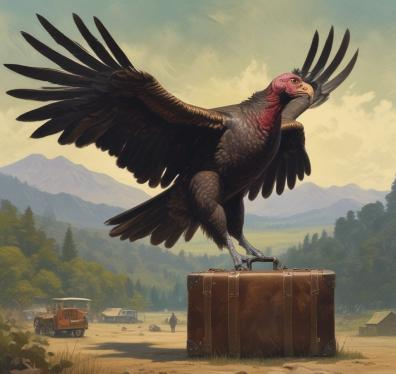 Native to the Americas, the turkey vulture (Cathartes aura) travels widely in search of sustenance. While usually foraging alone, it relies on other individuals of its species for companionship and mutual protection. Sometimes misunderstood, sometimes feared, sometimes shunned, it nevertheless performs an important role in the ecosystem. This scavenger bird is a marvel of efficiency. Rather than expend energy flapping its wings, it instead locates uplifting columns of air, and spirals within them in order to glide to greater heights. This behavior has been mistaken for opportunism, interpreted as if it is circling doomed terrestrial animals destined to be its next meal. In truth, the vulture takes advantage of these thermals to gain the altitude needed glide longer distances, flying not out of necessity, but for the joy of it. It also avoids the exertion necessary to capture live prey, preferring instead to feast upon that which is already dead. In this behavior, it resembles many humans. It is not what most of us would consider to be a pretty bird. While its habits are often off-putting, or even disgusting, to members of more fastidious species, the turkey vulture helps to keep the environment from being clogged with detritus. Hence its Latin binomial, which translates to English as "golden purifier." I rarely know where the winds will take me next, or what I might find there. The journey is the destination. |
| Regular readers know I'm a fan of etymology and other language studies. Here's one from NPR: For many in the business world, a return to work after the winter break will mean once again donning the dreaded suit and tie. Pretty sure that's falling out of fashion, except for, like, lawyers. The corporate neckwear is the everyday counterpart to the traditionally more luxurious cravat – a voluminous neckscarf that conjures up images of opulent dinners aboard a yacht sailing through the Mediterranean. It does no such thing for me. But I do know that what we call "a tie" is called "une cravate" in French, and France has a Mediterranean coast, so... whatever; I don't really have a point here, unlike my ties. Yes, I do own some. President Abraham Lincoln wore cravats, as did Hollywood actor Cary Grant and the extravagant entertainer Liberace. At least one, possibly all three, of those men were gay. Nothing wrong with that, of course, at least not from today's perspective; I'm just pointing out that it might be a factor. In more recent times, the garment has been popularized in the American mainstream by the likes of Madonna and the late Diane Keaton. Fashion has been moving toward more unisex styles, from what little I know of it. Nothing wrong with that, either. In this installment of NPR's "Word of the Week" series we trace the origins of the "cravat" (borrowed from the French "cravate") back to the battlefields of 17th century Europe and explore its links to the modern day necktie, patented in New York more than 100 years ago. That is, honestly, more recent than I thought modern neckties were. "Scarves worn around the neck existed long before, but the story of the cravat truly begins in the Thirty Years' War when it first gained wider European recognition," explains Filip Hren... As someone who has studied fighting skills, albeit briefly and without much enthusiasm, I've often wondered about that. Something worn tied around one's neck is a liability in a fight. Unless it's a fake, designed to throw the opponent off-guard when they grab it to strangle you, and it instead comes off in your hand, giving you at least a temporary advantage. Hren is referring to the 1618-48 conflict fought between Catholics and Protestants and known as Europe's last religious war. Heh. That's funny. The word "cravate" first appeared in the French language to describe military attire worn by Croatian mercenaries who were renowned among their enemies for their brutal fighting prowess. Looking like a fighter is at least half the battle. Not sure if Sun Tzu wrote that, but I believe it to be true. Made of silk or cotton, the cloth is said to have been used to protect their faces against cold weather and smoke in battle, and to treat injuries. For a while, neckwear existed with a practical purpose (for non-warriors): shirts didn't have top buttons, or had really bad top buttons, so they used ties (of various styles) to hold the collar closed for a cleaner, more formal look. For fighters, I can only imagine that they could turn its inherent disadvantage into an advantage: "I can kick your ass even with this liability looped around my most vital body connection." "The scarves took their names from Croats. It was tied in a Croatian manner, or in French – a la Croate," explains Filip Hren. And that, I didn't know until I read this article. As an aside, Croats should not be confused with the Croatoan, a native American tribe largely in what is now North Carolina. King Louis XIV introduced the cravat into French fashion and from Paris it soon spread across Europe. And who, in the history of the world, has had more impact on clothing fashion than the French? No one, I say. They also kick military ass. Coincidence? I think not. Over the years, the necktie has come to symbolize success, sophistication and status, but has also been criticized by some as a symbol of power, control and oppression. I don't really understand fashion, but I am rather attuned to symbolism (pretty much have to be, as a writer). Remaining unexplained, however, is the continued popularity of its cousin, the bowtie. |
| Here's a source I've never linked before, apparently some self-promoter called Michael Ashford: Not that self-promotion is inherently bad. But check how many times he (yes, I'm assuming gender) pushes his podcast, newsletter, book, etc. This does not mean the content is bad, either. Have you ever heard of the term “conflict entrepreneur?” Until my conversation with Martin Carcasson, I hadn’t heard it. That's because someone made it up. All words and phrases are made up, of course, just some more recently than others. This particular one isn't catchy or short enough to ever catch on, the way other phrases like "concern troll" have. I propose "strifemonger." ...the idea is simple: A conflict entrepreneur is someone who makes money and/or generates a large following by intentionally pitting people against each other. And they have been around since long before the internet. Unfortunately, conflict entrepreneurship is big business, and it’s scary. One of those things is opinion. It’s scary because it’s easy to rile up peoples’ sensitivities and emotions. You take that back RIGHT NOW! Perhaps most unsettling, it takes zero experience, financial backing, wisdom, or talent to become a successful conflict entrepreneur. Eh, I don't know about that. You gotta want to do it, and have some efficacy at it, and what's that besides talent? And you can earn experience along the way. We see example after example in popular media of people who make their living off of reducing complicated issues into black-and-white binaries, removing nuance from conversation in favor of parroted talking points, and stereotyping the many based off the actions of the few. This is, I think, the important part. Think about, for example, kiddy-diddlers. I know you don't want to think about kiddy-diddlers, but I'm making a point here. There's a meme (original sense of the word) going around that drag queens are bad and they shouldn't be around children because they'll diddle them. Whereas, here in reality, the vast, vast majority of kiddy-diddlers who aren't family (happens a lot) are fine, upstanding church or school leaders. And yet if ONE trans person got caught diddling a kid, they'd say it's because they're trans; while the fine, upstanding church or school leaders who diddle kids are "mentally ill" and "don't reflect the values of the group." In other words, if someone in the in-group does something bad, it's their fault (or we ignore it, as has been the case lately). If someone in the out-group does something bad, it's the entire out-group that's at fault. To a conflict entrepreneur, your anger and your discontent are their supply. Your desire to withdraw into a tribe and demonize anyone outside of it is the capital a conflict entrepreneur needs to continue to build their empire. Like I said. Our anger sustains them. Our frustration feeds them. We're raging all over the internet, and they're sitting there chuckling. Curious questions stop them in their tracks. Okay, first of all, no; second, first you'd have to find and identify them. This process of asking yourself questions, asking questions about others, and asking questions of others is at the heart of the... ...thing he's self-promoting. As usual, I'm not avoiding talking about something in here just because someone's trying to sell a book. We're mostly writers and readers here, with many interested in selling their books and many more (hopefully) interested in reading them. And I think the basic points here are sound: that strifemongers exist, that they're manipulating people for fun and profit, and there are ways to aikido the hell out of them. Now if I could just remember this the next time someone posts something deliberately inflammatory. |
| From The Conversation: No. There. Article over. Question answered. Done. Let's move on. Is the whole universe just a simulation? – Moumita B., age 13, Dhaka, Bangladesh Sigh. Okay. Fine. It's a kid's question. Probably best to not be all Calvin's Dad  on this one. on this one.How do you know anything is real? Some things you can see directly, like your fingers. Other things, like your chin, you need a mirror or a camera to see. Other things can’t be seen, but you believe in them because a parent or a teacher told you, or you read it in a book. And then there are things that are not real, but you think they are, because someone lied to you. Maybe the world we live in our whole lives inside isn’t the real one, maybe it’s more like a big video game, or the movie “The Matrix.” Okay, here's my biggest problem with the simulation hypothesis, apart from it being inherently untestable and non-falsifiable: I question the motives of anyone who insists that this is a simulation. I question them even more when someone uses the word "just" as a modifier. Now, I'm not going to apply that distrust to a 13-year-old who lives on damn near the exact opposite side of the planet from me, if indeed that person is real, but for grown adults, I wonder. Because when I'm in a simulation, and I know it's a simulation, my ethics go right out the window. I have no issue with depopulating entire towns in single-player games, for example. There are no consequences outside of the game. I also question them because this only became a popular question after The Matrix. Like, you couldn't come up with it yourself but had to have it fed to you on a screen? It was a science fiction movie, for fuck's sake. (So much for targeting this to kids.) It's like asking if Klingons are real, or if replicants are real. And to add another layer of whatever to it, I've studied religion, and the simulation hypothesis is just a modern incarnation of gnosticism. The simulation hypothesis is a modern attempt to use logic and observations about technology to finally answer these questions and prove that we’re probably living in something like a giant video game. This shouldn't be too advanced for a 13-year-old: the burden of proof is on the hypothesizers. It is not on the rest of us to prove that we're not living in a simulation. Twenty years ago, a philosopher named Nick Bostrom made such an argument based on the fact that video games, virtual reality and artificial intelligence were improving rapidly. The argument has been around longer than that. Matrix came out in what, 1999? 27 years ago. That's when people in my circles started asking the question. Here’s Bostrom’s shocking logical argument: If the 21st century planet Earth only ever existed one time, but it will eventually get simulated trillions of times, and if the simulations are so good that the people in the simulation feel just like real people, then you’re probably living on one of the trillions of simulations of the Earth, not on the one original Earth. And here's where that "logical" argument falls flat on its face: We do not currently have the capability to create a simulation where the people in the simulation feel just like real people. Maybe we're close, maybe not, but we're not there. This eliminates every one of the trillions (some say infinite, which is a hell of a lot more than trillions) of intermediate simulations, leaving us with exactly two possibilities: we're in the real world, or we're in an unadvanced simulation. The argument from probability thus evaporates like the words on a computer you've just turned off. If we are living in a simulation, does that explain anything? Maybe the simulation has glitches, and that’s why your phone wasn’t where you were sure you left it, or how you knew something was going to happen before it did, or why that dress on the internet looked so weird. Or, maybe, our brains are just plain weird. See, there is one simulation hypothesis that I am pretty well convinced of, which is that what we experience is filtered to our brains through our senses. No outside influence, no god, no monster, no advanced technology is required for that hypothesis, just natural evolution. But Bostrom’s argument doesn’t require any scientific proof. It’s logically true as long as you really believe that many powerful simulations will exist in the future. No, that doesn't work, and it takes real mental gymnastics to make it work. But, you know... our brains are weird and can make such gymnastics. That’s why famous scientists like Neil deGrasse Tyson and tech titans like Elon Musk have been convinced of it, though Tyson now puts the odds at 50-50. Calling Musk a "scientist" is like calling me a football player. Or a scientist, for that matter. He's not. Not by any stretch of the imagination. And apparently I get to mention Tyson twice in two consecutive entries; he seems to have reached the same conclusion that I did. Even though it is far from being resolved, the simulation hypothesis is an impressive logical and philosophical argument that has challenged our fundamental notions of reality and captured the imaginations of millions. Here's my essential caveat, though: I don't think we should dismiss these ideas out of hand, any more than we should dismiss the idea of space aliens out of hand. It's just that, in the words of a real scientist, "Extraordinary claims require extraordinary evidence." But I am moved to ask: even if this is a simulation, what difference would that make? If it's so you don't have to take responsibility for your actions, like when I "kill" everyone in a fantasy town, then we're going to have a problem. If it's so you can believe there's some higher power guiding it all, then it's basically techno-gnosticism. Religion. Which is not science. If it's so you can believe you're special and everyone else is an NPC, then it's techno-solipsism. And borders on conspiracy theory thinking. If it's merely an academic question, then fine. I'm all for searching for deeper realities. That's what science does, in part. And then it's not "just" a simulation; it's just reality. If it's true. Which it's not. |
| This Big Think article is from December. You know, that special time of year when they gotta retrospect all the things. 10 scientific truths that somehow became unpopular in 2025  Scientific truths remain true regardless of belief. These 10, despite contrary claims, remain vitally important as 2025 draws to a close. Yes, I'm going to quibble about the headline before even getting into the article: "Scientific truths remain true regardless of belief" right up until new science tweaks the old truths. Some take issue with this, but personally, I embrace it. Neil deGrasse Tyson once said, “The good thing about science is that it's true whether or not you believe in it.” As regular readers know, I'm a big fan of science. Science is cool. Science (combined with mathematics) is the absolute best method we have for understanding the universe (and perhaps beyond). No other philosophical system even comes close, not even actual philosophy. But that quote? a) science gets overwritten by more science all the time; and b) religious people can, and often do, make the same claim about religion. And that's not even getting into the accusations leveled against Tyson; it's possible to be right (or wrong) about some things and also be a sex pest. However. Science is overturned by more science, not by people who've seen a few YouTube videos or listened to the disinformation specialists on social media. Certainly not by people who claim divine inspiration. And when it comes to scientific "truths," some are more certain than others. For example, there's a really extraordinarily high level of certainty when it comes to things like how atoms combine to make molecules, but significantly less for things like nutrition science. So, with that lengthy disclaimer out of the way, here's (some of) the article. No matter what it is that humans do — what we think, feel, accomplish, believe, or vote for — our shared scientific reality is the one thing that unites us all. Well. Except for that subset of "us all" who insist that there's no such thing as objective reality. Moreover, some of the quantum rules that govern reality are fundamentally indeterminate, limiting our ability to predict a system’s future behavior from even an arbitrarily well-known starting point. I'm pretty sure that chaos theory (which is what he's describing there) doesn't rest on quantum mechanics alone. And I'd make a distinction between "indeterminate" and "unpredictable." But again, those are probably quibbles. Still, scientific truths remain true, even if there are very few who accept them. Gravity worked for billions of years before humans figured out the rules that govern massive objects. Life formed, thrived, and evolved for billions of years before humans discovered evolution, genetics, and DNA. There is a probably-untestable hypothesis that the universe sprang into being, fully formed, just a few seconds ago, along with all of our memories and literature and science. This seems far-fetched, of course, but by the rules of quantum mechanics, it's not impossible; and given infinite spacetime, anything that's not impossible happens. There is another, older, probably-untestable hypothesis that you are the only consciousness, and everything else is a product of your imagination. These things are fun to think about and maybe write science fiction about. I don't actually believe them. But I suspect some people do. If, at any rate, those people actually exist and aren't products of my admittedly twisted imagination. However, many scientific truths have fallen out of public favor in recent times. Now, in 2025, some of the misinformation that’s replaced those truths has been elevated to prominence, and many cannot tell fact from fiction any longer. Whether you believe them or not, here are 10 scientific truths that remain true, even though you might not realize it here in the final month of 2025. None of my commentary here is meant to override the matters covered in this article. It is only to say that I understand, on some level, how one could deny these things. As always, I'm only covering a portion of this. There's quite a bit more at the link, including pretty pictures and graphs of questionable utility. 2.) Interstellar interlopers are real, and while we found a new one (only the third ever) in 2025, they are still not aliens. When I was a kid first getting hooked on astronomy, as I recall, at one point I was learning about comets and their orbits. I have a memory of being taught that some comets could have a hyperbolic trajectory, not an elliptical one, because they came from outside the solar system and would return to outside the solar system. Apparently, that was hypothetical back then. If I can even trust my memory at all. It might be something like extrasolar planets: We knew they had to be there, but there was never any direct or even indirect evidence. As for "they are still not aliens," 1) technically, they are aliens, by some definition, as they are alien to our solar system; 2) dismissing the idea out of hand that they're the product of tech-using space aliens is contrary to science and inquiry; 3) continuing to believe that they're the product of tech-using space aliens when there's overwhelming evidence that they're not is also contrary to science and inquiry. In short, it's awesome that we can track objects visiting us from extrasolar space, but screaming about space aliens doesn't help anyone's credibility. Regardless of what you believe (or what anyone believes), this object is a natural comet-like interloper originating from beyond our Solar System, and has absolutely nothing to teach us about alien life beyond Earth. First part: high probability of truth. Second part: I wouldn't jump to that conclusion. Such objects might very well provide insights into the early stages of life's development. Not sentient life, mind you. 4.) Earth’s orbit has a finite “carrying capacity,” and if we exceed that, such as with megaconstellations of satellites, it will inevitably lead to Kessler syndrome. Remember, this is a "truth" that is dismissed or ignored. You'd have to go to the article, or elsewhere on the internet, for a fuller explanation (spoiler: Kessler syndrome has nothing to do with a starship making the Kessel run in 12 parsecs). But, to me, this is an absolutely prime example of the tragedy of the commons: there's no overriding authority to regulate the number of satellites in orbit, so people keep lofting them up there. Readers of science fiction have known about this problem since, I don't know, at least as long as I've been alive. It hasn't even been 100 years since we first figured out how to put satellites in orbit, and already we're fucking it up. 5.) The germ theory of disease is real, and vaccination is the safest, most effective strategy to combat these deadly pathogens. Denial of this royally pisses me off, and sometimes I wish there were a Hell so frauds like Andrew Wakefield, who falsely claimed a link between vaccines and autism, could burn in it forever. Besides, believing that falsehood is basically saying "I'd rather have a dead child than an autistic one," which I can only imagine pisses off actual autistic people. 7.) The Universe’s expansion is still accelerating, the Hubble tension remains an important puzzle, and the much-publicized evidence we have is insufficient to conclude that dark energy is evolving. Look, unlike the vaccine thing, this one's pretty damn esoteric. We have to live here on Earth with the consequences of vaccine denial (and of climate change, which the article covers but I didn't quote). But this? I say let the cosmologists sort it out. I want to know the answers, too, but it tells me absolutely nothing about whether I should get a measles booster or try to recycle more stuff. To be clear, this doesn't mean I'm dismissing anything. Just that it doesn't impact anything apart from my own innate curiosity—at least, as far as I know. 9.) We’ve found evidence for organics on Mars (again), but still have no good evidence for life on any planet other than Earth. It’s important to remember, especially when specious claims about the existence of aliens are at an all-time high, that we still have no robust evidence for the existence of life on any planet or world other than Earth. Sure, other worlds could be inhabited. As with the exoplanet thing, or the extrasolar comet thing, it would be absolutely shocking if life (by which I mean simple life) doesn't exist outside our tiny planet. But until they find actual evidence, I for one am not interested in leaping to conclusions. I mean, as a fiction writer, it's fun to play with the idea, and I like Star Trek as much as the next person (and probably more), but my answer to everything unknown isn't to shrug and say "must be space aliens." Unless I'm making a joke. Which, if there's anything I enjoy more than science, it would be that. These 10 truths, although they should be completely non-controversial in a world that values factual reality, are often disputed here in 2025. Despite their unpopularity, they’re just as true as they’ve ever been, and will likely remain true for a long time to come. Don’t let anyone convince you otherwise until they’ve obtained the extraordinary evidence needed to convince even a skeptic; if the evidence cannot yet decide the matter, then the matter hasn’t been decided. All that said, I would absolutely change my mind about space aliens if a flying saucer landed in my street. Actually, my personal level of proof is way lower than that; I don't need to experience something directly to believe in it. But there needs to be a higher level of support than any "alien hypothesis" has now, even when it comes to UFO/UAP sightings. So, in brief, while I think the article's on the right track, I do feel like it's a bit simplistic and/or misleading in a couple of places. That's okay, though. It gives me something to write about. Its true sin, though, in my view anyway, is not staying on track with the "this is a truth that some people choose to deny" thing, and the subject headers are all over the place with that. I think I figured it out through context clues, though. |
| Contrary to popular belief, it is not true that I do nothing. The truth is, I do nothing useful. Here's a Guardian article on how to do nothing: The perfect way to do nothing: how to embrace the art of idling We are often so busy and yet when the opportunity arises to do nothing, we can find it uncomfortable. Here’s how to lean into boredom – and unlock the imagination You would think that, of all the things we do, you wouldn't need a how-to guide for doing nothing. It'd be like if Lifehacker put out a "You're drinking water wrong" article. Please, please don't tell me they already have. There are limits to my curiosity, and one of those limits is not wanting to know just where the bottom of the barrel is. On a rainy afternoon last weekend, plans got cancelled and I found myself at a loose end. Given that I’m someone who likes to have backup plans for my backup plans, my initial response was panic. Now what? I wandered aimlessly from room to room, grumpily tidying away random items. In fairness, cleaning is the thing I do when I've absolutely, completely, and totally run out of anything else to do. For good measure, I organised a triage box containing plant food, a mister and a watering can. Why are we still calling them "misters"? That's sexist as hell. Despite the palpable benefits, my initial reluctance to slow down is not unusual. Research has shown that people often underestimate the extent to which they will enjoy inactivity. There’s a tendency for human beings to prefer to do something, even something unpleasant, than the alternative. It is true that I do not enjoy inactivity. What I enjoy is doing things that benefit no one at all, such as playing video games. Well, I suppose if I pay for the video games, I'm benefiting someone. I'll have to try harder to benefit no one. This was proved to an extraordinary degree by Harvard University psychologists whose study revealed that given the choice between sitting alone with their thoughts for as little as six to 15 minutes or giving themselves an electric shock, participants preferred to be zapped. In fairness, lots of people enjoy being zapped. In skepticism, if you know that there will be no lasting negative (pun intended) effects from getting shocked, why not choose that over doing nothing? At least you're learning what it feels like to be shocked. A true study would determine if people would rather sit alone with their thoughts for 15 minutes, or have a finger cut off without anesthesia. But I suspect that would violate some pesky ethics rule. There’s another factor: guilt – particularly about appearing to be lazy. Increasingly, being busy carries a sense of status and moral superiority. “Many of us grew up with the phrase ‘the devil will find work for idle hands’,” says Treanor. Aw, man, I thought that was an American Puritan thing. You know, the group England kicked out. Many of us simply fear boredom. Sandi Mann is a psychologist at the University of Lancashire and author of The Science of Boredom. Her research revealed that boredom, far from being a bad thing, can make us more creative. I'm sorry. I'm truly, truly, sorry. But the idea of a boredom book being written by someone named Sandi Mann just triggers every absurdist neuron in my brain. ...because Sandman? Get it? Huh? Huh? I'll be here all week. When we’re alert and fully rational, our critical, judging mind is ruling the show. Or as Mann puts it: “If you’re daydreaming, you haven’t got that inhibition, that voice in your head saying, ‘Don’t be silly, that’s a ridiculous idea!’ Instead, our minds are free to roam outside the box looking for things we wouldn’t necessarily come up with when we are more conscious.” Assertion without evidence. (That "we" can be fully rational and that "we" have critical minds.) If you want to get better at being productively unproductive, there are strategies. “See it as an experiment and bring some lightness and play into it,” suggests Treanor. Nah. I just want to find ways to be even more completely useless. If you’re feeling really brave, she suggests going cold turkey and sitting doing nothing for two minutes. “Be proud of yourself for having a go. Acknowledge that it’s really hard and uncomfortable. You don’t have to judge yourself for not enjoying it. Next time you could try for longer.” But that's two minutes I could have spent looking at cat videos. There's a lot more at the link. You can go visit it. Or you can do something else. Or you can do nothing. Whatever. |
| For no other reason than I found this amusing, an article from Smithsonian: A Cat Left Paw Prints on the Pages of This Medieval Manuscript When the Ink Was Drying 500 Years Ago An exhibition called “Paws on Parchment” tracks how cats were depicted in the Middle Ages through texts and artworks from around the world—including one example of a 15th-century “keyboard cat” Now, this might be a paid ad for the museum running the exhibition. But even if it is, the article is informative by itself. More than 500 years ago, after dedicating hours to the meticulous transcription of a crucial manuscript, a Flemish scribe set the parchment out to dry—only to later return and discover the page smeared, filled with inky paw prints. I hope the scribe didn't punish the poor kitty. “Objects like [the manuscript] have a way of bridging across time, as it’s just so relatable for anyone who has ever had a cat,” Lynley Anne Herbert, the museum’s curator of rare books and manuscripts, tells Artnet’s Margaret Carrigan. “Many medieval people loved their cats just as much as we do.” The common perception is that Europeans, back then, hated and/or feared cats, believing them to be agents of the devil (which, to be honest, I can kind of understand). And I've heard they were blamed for the Plague, or at least one of the Plagues, therefore killed en masse, thus eliminating a check on the rodent population, in turn enabling the spread of the flea with the plague germs. I can hear someone from that time right now if I tried to explain that to them: "But still, it's cats." Anyway, point is, I'm sure that then, as now, there were people who liked and appreciated cats. Though maybe liked them a little less when they left paw prints on your manuscript. This affection is evidenced by the myriad illustrations of cats across cultures. After finding the Flemish manuscript, Herbert searched the museum archives and found no shortage of other feline mentions or depictions in Islamic, Asian and other European texts and images. Also, apparently, they're not limiting it to Europe. And a 15th-century painting called Madonna and Child With a Cat features a small kitten beside the newborn baby Jesus. The depiction is likely a reference to the lesser-told Christian legend that a cat gave birth to a litter of kittens inside the manger at the same time that Mary gave birth to Jesus, according to the museum. And yet, to the best of my knowledge, no one worships those kittens or their mother. It's just not fair. “Paws on Parchment” is the first of three exhibitions over the next two years dedicated to animals in art. Its displays have already made an impression on viewers, human and feline alike. Shortly after its grand opening, in partnership with the Baltimore Animal Rescue and Care Shelter, of four 6-week-old foster kittens were given a private tour. Herbert adopted two of them. Hopefully they won't do that with the elephant exhibit. Anyway, not much to the article which, as I say, may very well be an ad. But it has pictures. Including pictures of the 6-week-old foster kittens from that last quote. I'll just end with this: a while back, I had to get part of my basement slab redone. They poured new concrete and, as the concrete was curing, my cat at the time decided to walk in it. He did not like having his paws washed afterward, but I never did anything about the prints in the concrete. So the next owner of this house is going to get a nice surprise. |
 View Portfolio
 Visit Notebook
 Send Gift Points
 Awards
 Badges
 Send Email


 Community Newsfeed
 Puzzle Hub
 General Discussion
 Sponsored Items
 Book of Trinkets
 Static Items
 Books
Books Groups
 Interactive Stories
 Audio
Audio Campfire Creatives
 Community Notes
 Crossword Puzzles
 Documents
 Folders
 Images
 In & Outs
 Madlibs
 Photo Albums
 Polls
Polls Product Reviews
 Quizzes
 Survey Forms
 Web Pages
 Word Searches


