%%USERNAME%%    %%ACCWORDS%% %%ONOFF%% |




 Items to fit into your overhead compartment |
|
Carrion Luggage 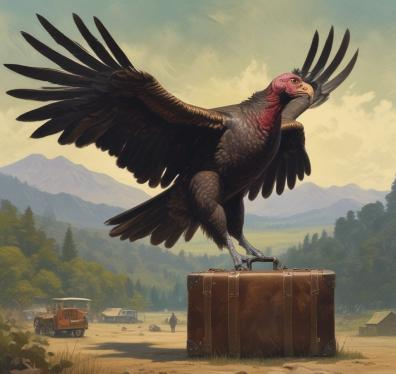 Native to the Americas, the turkey vulture (Cathartes aura) travels widely in search of sustenance. While usually foraging alone, it relies on other individuals of its species for companionship and mutual protection. Sometimes misunderstood, sometimes feared, sometimes shunned, it nevertheless performs an important role in the ecosystem. This scavenger bird is a marvel of efficiency. Rather than expend energy flapping its wings, it instead locates uplifting columns of air, and spirals within them in order to glide to greater heights. This behavior has been mistaken for opportunism, interpreted as if it is circling doomed terrestrial animals destined to be its next meal. In truth, the vulture takes advantage of these thermals to gain the altitude needed glide longer distances, flying not out of necessity, but for the joy of it. It also avoids the exertion necessary to capture live prey, preferring instead to feast upon that which is already dead. In this behavior, it resembles many humans. It is not what most of us would consider to be a pretty bird. While its habits are often off-putting, or even disgusting, to members of more fastidious species, the turkey vulture helps to keep the environment from being clogged with detritus. Hence its Latin binomial, which translates to English as "golden purifier." I rarely know where the winds will take me next, or what I might find there. The journey is the destination. |
|
You know those "which Hogwarts house are you?" quizzes designed to fill out your ad profile online? I don't know; maybe they've finally fallen out of favor. Here's a different kind to consider, from Big Think, and I'm not even building an ad profile of you: Which of the 5 philosophical archetypes best describes you?  I'm definitely a Kitsune, but would a Kitsune actually say that? For clarity, that subhead there is the author describing himself as a Kitsune. I'm absolutely not a Kitsune, though I appreciate them. Sometimes. We are all philosophers. I don’t mean this in the “What do you make of Quine’s ‘Two Dogmas’?” sense. No, we are all philosophers in that we all do philosophy. Yeah, even that insipid song by Edie Brickell with the line "philosophy is the talk on a cereal box" is a kind of philosophy. Philosophy is a practice of wonder and logic; curiosity and introspection; dialectic and meditation; criticism and advocacy. I question the author's assertion here, but I guess that means I'm doing philosophy. So, without any empirical rigor whatsoever — another favorite characteristic of philosophy — I present here five different ways to be a philosopher. I feel like "The Fool" is conveniently left out, though maybe that's an aspect of the Kitsune. Yes, yes, I'm getting to what that is, if you don't already know. But that's because I assert that philosophers, by definition, have a stunted sense of humor, or none at all. We have a different word for philosophers with a sense of humor: comedians. The Sphinx The archetype: The Sphinx had the head of a woman, the body of a lion, and the wings of a bird. While that kind of chimera is probably highly symbolic, I don't know what the symbols might mean. Physical descriptions are probably the least important things in these archetypes. Each time, the Sphinx would ask a single riddle, the classic being, “What walks on four legs in the morning, two at noon, and three in the evening?” but I assume there were more. One of my favorite scenes in fiction is from a Zelazny novel. The MC meets a sphinx, who asks him a riddle. He asks, in return: "What's red and green and goes round and round and round?" This stumps the sphinx, because of course the sphinx isn't attuned to the modern definition of "riddle." He is thus able to pass while the sphinx ponders, much like when Spock set an android into an infinite loop with deliberate illogic. This is probably when I determined the essential difference between philosophers and comedians. Oh, the answer is "a frog in a blender." The Leviathan The archetype: The Leviathan is a demonic sea serpent that breathes fire. Its back is a row of shields and churns the oceans to a frothing boil. Not ever answered: what use fire-breathing has in a sea monster. This person has a transferable framework that they apply to everything. They’ve read a book, studied a philosophy, or watched a YouTube video and decided, “Yes, this idea is the one that will govern my life.” Every action in every minute of the day can be explained by this single system of ideas. Oh. That type. The Kitsune The archetype: In Japanese folklore, the kitsune is a fox spirit known for their ability to shapeshift. A kitsune might appear as a beautiful woman, an old man, a child, or a tree. Some are tricksters, and others are teachers. The "trickster" archetype can be funny. But not usually to the ones being tricked. The kitsune-person may say something outrageous and, when challenged, give a wide smile with a twinkle in their eye. They’re often impossible to argue with because they keep changing things. Oh, yeah, the goalpost-mover. The Minotaur The archetype: The Minotaur is a half-human, half-beast (typically a bull) locked in a labyrinth. The Minotaur is feral and brutal, no doubt — he will kill anyone he catches in his maze — but he is also lost and tormented. In my view, the "bull" part is essential to the minotaur's description. It's right there in the name. ("But, Waltz, what about centaurs? They're part horse, not bull." "Turns out one possible etymology for 'centaur' is 'bull-slayer.'") The minotaur-philosopher is someone lost in the mire of human suffering, mortality, freedom, and absurdity. They never escape the labyrinth but make a dark, resigned home within it. Here, you’ll find Pascal, Dostoevsky, Heidegger, Sartre, Camus, and Simone de Beauvoir pacing about in anguish. No comment. The Garuda The archetype: The Garuda is a great eagle of Indian mythology and is associated with clear sight and the dispelling of poisons — especially those of serpents and nagas. The Garuda soars above the landscape and sees the structure of things. One might think that because it's a big-ass bird associated with purification, I'd identify most closely with this. One would be wrong. The Garuda-person asks, “What do you mean by that?” a lot. They hate vagueness and metaphor used as arguments and will often call out both — “What does that actually mean?” they say. They generally don’t have time for “lived experience” or emotional reasoning. Or, I don't know. Maybe that's pretty close. Fuller descriptions exist at the link, of course. While, as the author notes, the list is by no means exhaustive, I find it amusing. I'm also quite pleased that it's not limited to one set of mythology, though there are certainly others that could be included, from other cultures. Though the "trickster" archetype seems to be pretty universal. And most of us are composites — a little Sphinx when we’re unsure, a little Minotaur late at night, a little Garuda when we’re fed up with nonsense. I'd venture that most of us just are, without thinking about archetypes. Hm. Maybe Edie Brickell was onto something, after all. |
 View Portfolio
 Visit Notebook
 Send Gift Points
 Awards
 Badges
 Send Email


 Community Newsfeed
 Puzzle Hub
 General Discussion
 Sponsored Items
 Book of Trinkets
 Static Items
 Books
Books Groups
 Interactive Stories
 Audio
Audio Campfire Creatives
 Community Notes
 Crossword Puzzles
 Documents
 Folders
 Images
 In & Outs
 Madlibs
 Photo Albums
 Polls
Polls Product Reviews
 Quizzes
 Survey Forms
 Web Pages
 Word Searches


